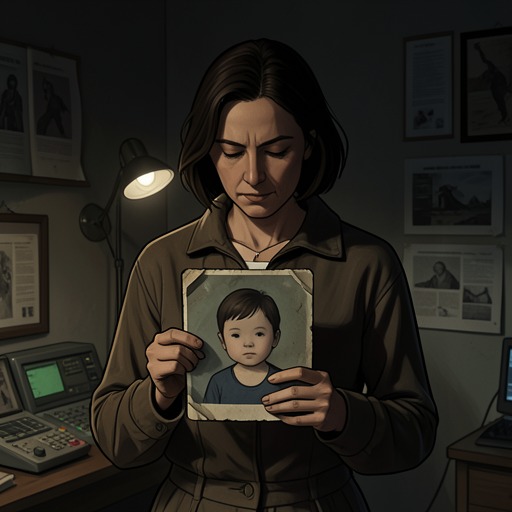
Owen’s concealed identity and past
The Last Thing He Told MeOwen Michaels’s concealed identity and past become the central mystery when an investigation finds that the biography he gave Hannah Hall cannot be matched to a real person in the records. The discovery does not identify who he was before Sausalito, but it changes the meaning of his disappearance: his family life appears to have been built around an identity with a remarkably short documentary history, and his flight may have been driven by the risk that authorities would uncover what came before.
The Identity Problem
Jake Bradley Anderson first puts the contradiction bluntly: the Owen Michaels described in Hannah Hall’s account does not exist. Hannah resists the conclusion because Owen is not an abstraction to her; Bailey Michaels is sleeping nearby, and their shared life is tangible. Jake then narrows his claim. A birth certificate and Social Security number match the names Owen and Bailey used, but the other details do not cohere into a person with Owen’s reported biography.
The investigator Jake consulted finds several people named Owen Michaels who grew up in Newton, Massachusetts, and others who attended Princeton University. But the only record matching both the reported hometown and Princeton attendance belongs to a seventy-eight-year-old man living with his partner, Theo Silverstein, in Provincetown, Cape Cod. The mismatch does not prove which parts of Owen’s history were invented; it shows that the combination of name, education, and hometown in his story cannot be verified as belonging to him.
Hannah receives the news physically as well as intellectually. She sits on the hallway carpet with her back against the wall, struggling to breathe and steady herself as the idea passes through her that no documented Owen Michaels is the man she married. Her first response is disbelief, but the investigative details make the contradiction harder to dismiss than a simple suspicion about his disappearance.
A Life That Begins in the Records in 2009
The absence is specific. The investigator finds no record of Owen purchasing or owning a home in Seattle in 2006, enrolling Bailey in preschool there that year, or filing a registered income-tax return before 2009. Hannah recognizes 2009 as the year Owen and Bailey moved to Sausalito. From that point onward, the investigator says, the available record broadly matches the life Hannah knows: their home, Bailey’s schooling, and Owen’s work.
That dividing line—nothing that supports the earlier account, then a largely consistent trail from Sausalito onward—makes the move more than a change of address. It is where the documented version of Owen’s life begins. Jake notes that the family’s floating home left less of a trace than an owned house would have: Owen did not own the land beneath it, and the arrangement was closer to a rental. In Jake’s explanation, that made the home harder to trace and reduced the paper trail attached to the family’s new life.
The records therefore offer neither a complete biography nor a clean answer about the past. They establish that the story Owen told Hannah before Sausalito lacks supporting data, while leaving open whether he used another name or kept the same name and lied about the rest. Jake’s conclusion is that Owen lied about who he was; the investigation described here does not recover the missing identity or specify the full extent of the deception.
The Shop and the Erasure of a Trail
The record gap is complicated by The Shop’s software. When Hannah invokes information from a friend, Jake points out that one of the software’s main functions is to alter a person’s online history and erase unwanted traces. Its reach includes online university databases and housing records—the very kinds of records whose absence makes Owen’s earlier biography so difficult to verify.
Jake consequently turns the question back on the company’s own technology: if Owen’s record was expunged, Owen himself may have been the person capable of doing it. This is presented as a possibility, not a demonstrated finding. The software provides a plausible mechanism for why searches might come up empty, but the evidence does not confirm that Owen used it to erase his own history. His missing records can point toward deliberate concealment without, by themselves, identifying who caused it.
That tension gives Owen’s assumed identity a practical dimension. A name is not sustained by personal testimony alone; it is also connected to school, housing, income, and online records that institutions can search. Here, those records fail to establish his earlier life, while The Shop’s capacity to alter online history makes the failure itself ambiguous. The same absence can look like proof of a fabricated biography or the result of an erased trail.
Jake’s Theory of Flight
Jake considers why someone would construct a false identity. The possibility of another wife is raised, but his working theory is that Owen was involved in earlier criminal activity and ran to avoid trouble, start over, and protect his family. Jake describes this as a pattern he believes often ends badly when a person’s past catches up with the new life. It remains his theory, rather than a confirmed account of Owen’s prior conduct.
The current crisis at The Shop gives that theory an immediate context. Jake reasons that Owen knew the company’s collapse would expose him and that he feared his past being uncovered. In a later explanation, he says the publicity surrounding the scandal would have made Owen’s image widely visible and could have enabled people connected to Nicholas Bell’s employers to find him again. Owen’s departure, on this account, was also an effort to prevent Bailey’s life from being engulfed by that exposure.
The risk of identification was not limited to photographs. Jake says Owen would have been brought in and fingerprinted, as Jordan Maverick had been that afternoon; fingerprinting, he explains, would have revealed who Owen actually was. That prospect makes the missing identity more consequential than a secret biography. An ordinary law-enforcement procedure could connect the man living under the name Owen Michaels to the person behind it, leaving no room for the new life to hold.
What the Evidence Does and Does Not Establish
When Hannah asks whether the authorities believe Owen is guilty, Jake distinguishes suspicion from proof. The FBI and others, in his account, need answers from Owen; that is not the same as deciding that he willingly participated in The Shop’s fraud. Jake says he considers willing participation unlikely. His view preserves a distinction between the company scandal that precipitated Owen’s exposure and the unidentified past that may explain why exposure was so dangerous to him.
Owen’s concealed identity thus remains unresolved, but its effects are clear. His biography cannot be corroborated before the family’s arrival in Sausalito; from 2009 onward, the records align more closely with Hannah’s experience; and the possibility of erased digital traces complicates any simple reading of the gap. The revelation recasts his disappearance as an escape from identification as well as a response to The Shop’s collapse, while leaving Hannah without the answer she needs most: the name and history of the man whose life she thought she knew.